
Understanding Dry Eye

Why drops are sometimes not enough for dry eye relief.

Two women laughing

What are Meibomian Glands?

Normal gland image

A meibomian gland structure ranges anywhere from normal to significant gland loss.

Shortened gland image

Meibomian glands secret lipids - the oily part of tears - which are a key component to the tear film that helps maintain a healthy ocular surface. When meibomian glands function correctly, these lipids reduce eye surface water evaporation.

Gland loss image

When meibomian glands become blocked, the lipids cannot be released. The absence of lipids causes watery tears to dry up quickly, resulting in dry eye symptoms which can cause discomfort and sometimes blurry vision.


Left untreated, meibomian gland issues progress. Over time, the glands become completely obstructed, which then leads to meibomian gland atrophy, resulting in permanent changes in the tear film.

Note: Images for illustrative purposes only. Actual results may vary.

Source of Most Dry Eye Symptoms

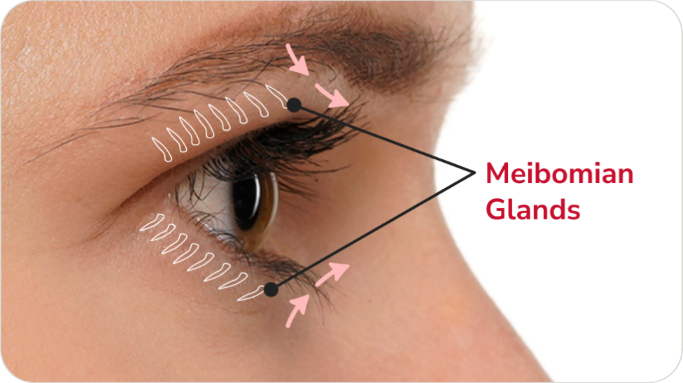
Melbomian Glands image illustration

Your meibomian glands produce the oily part of the tear film needed to protect the surface of your eye by preventing the evaporation of the watery part of your tears. When this function is not working well, your eyes may feel dry

In One Study, 86% of all Dry Eye Patients Had Issues with their Meibomian Glands1

Dry Eye may worsen over time, leaving eyes feeling more irritated, inflamed, and dry.2 Despite how it sounds, the cause of Dry Eye is rarely due to a lack of the watery part of your tears, but rather an insufficient lipid layer that is needed to prevent the watery part from evaporating too quickly between blinks.

Who's Affected?

Studies have shown that issues with the meibomian glands were more prevalent in (the following high risk groups):

  • 60% of contact lens
 wearers3
  • 86.8% of perimenopausal women4

  • 57% of diabetics5
  • 80% of glaucoma patients6

  • 52% of cataract patients7


Plus, in a separate study, 72.5% of patients presenting for refractive surgery evaluation had meibomian gland atrophy (indicative of issues with meibomian glands).8

Can You Answer Yes to These Dry Eye Symptom Questions?

If 'Yes', you may want to ask your eye doctor about Dry Eye.

My eyes are so irritated.

Do your eyes feel dry,
gritty, and scratchy?

I often find myself rubbing my eyes.

Do you experience burning
and watery eyes?

Eye drops haven't helped.

Do you often use eye
drops and other means for
short term dry eye relief?

My eyes are becoming a distraction.

Do your dry eye
symptoms get in the way
of your daily activities or
work?

Sometimes I can't keep my eyes open.

Do your eyes often feel
tired?

I frequently have to remove my contacts.

Are you able to wear
contact lenses?

Activities or Conditions that may Contribute to Dry Eye11:

  • Allergies
  • Computer/device use
  • Environment
  • Eye surgery
  • Glaucoma/chronic eye diseases
  • Poor blinking
  • Climate
  • Contact lens wear
  • Eye infections/styes9
  • Gland-clogging makeup10
  • Medications
  • Reading/TV watching
Couple holding hands

Dry Eye Treatment

If you have been told that your dry eye is related to your Meibomian Glands, there is something that can be done about it. 

References:

  1. Lemp MA, Crews LA, Bron AJ, Foulks GN, Sullivan BD. Distribution of aqueous-deficient and evaporative dry eye in a clinic-based patient cohort: a retrospective study. Cornea. 2012 May;31(5):472-478.
  2. Nichols KK, Foulks GN, Bron AJ, et al. The international workshop on meibomian gland dysfunction: executive summary. Invest Ophthalmol Vis Sci. 2011 Mar;52(4):1922-1929.
  3. Machalinska A, Zakrzewska A, Adamek B, et al. Comparison of morphological and functional meibomian gland characteristics between daily contact lens wearers and nonwearers. Cornea. 2015 Sep;34(9):1098-1104.
  4. Jin X, Lin Z, Liu Y, Lin L, Zhu B. Hormone replacement therapy benefits meibomian gland dysfunction in perimenopausal women. Medicine (Baltimore). 2016 Aug;95(31):e4268. doi: 10.1097/MD.0000000000004268. PMID: 27495030; PMCID: PMC4979784.
  5. Shamsheer RP, Arunachalam C. A Clinical Study of Meibomian Gland Dysfunction in Patients with Diabetes. Middle East Afr J Ophthalmol. 2015 Oct-Dec;22(4):462-6. doi: 10.4103/0974-9233.167827. PMID: 26692718; PMCID: PMC4660533.
  6. Uzunosmanoglu E, Mocan MC, Kocabeyoglu S, Karakaya J, Irkec M. Meibomian gland dysfunction in patients receiving long-term glaucoma medications. Cornea. 2016 Aug;35(8):1112-1116.
  7. Cochener B, Cassan A, Omiel L. Prevalence of Meibomian Gland Dysfunction at the time of cataract surgery. J Cataract Refract Surg. 2018 Feb;44(2):144-148.
  8. Brooks CC, Gupta PK. Meibomian gland morphology among patients presenting for refractive surgery evaluation. Clin Ophthalmol. 2021;15:315–21.
  9. Duke University website. Immune response likely culprit in eyelid gland condition that causes dry eye. Found at: https://dukeeyecenter.duke.edu/news/immune-response-likely-culprit-eyelid-gland-condition-causes-dry-eye, July 2018. Accessed 3rd July 2026.
  10. American Optometric Association, Paraoptometric Resource Center, CPC Submission, T Petrosyan. Cosmetics and the eye: how your beauty products could be harming your eyes. Found at: https://www.wpa-eyes.org/wp-content/uploads/2018/11/Cosmetics-and-the-Eye.pdf, 2018. Accessed 3rd July 2026.
  11. Schaumberg DA, Nichols JJ, Papas EB, Tong L, Uchino M, Nichols KK. The international workshop on meibomian gland dysfunction: report of the subcommittee on the epidemiology of, and associated risk factors for, MGD. Invest Ophthalmol Vis Sci. 2011 Mar;52(4):1994-2005.
2026PP09183