
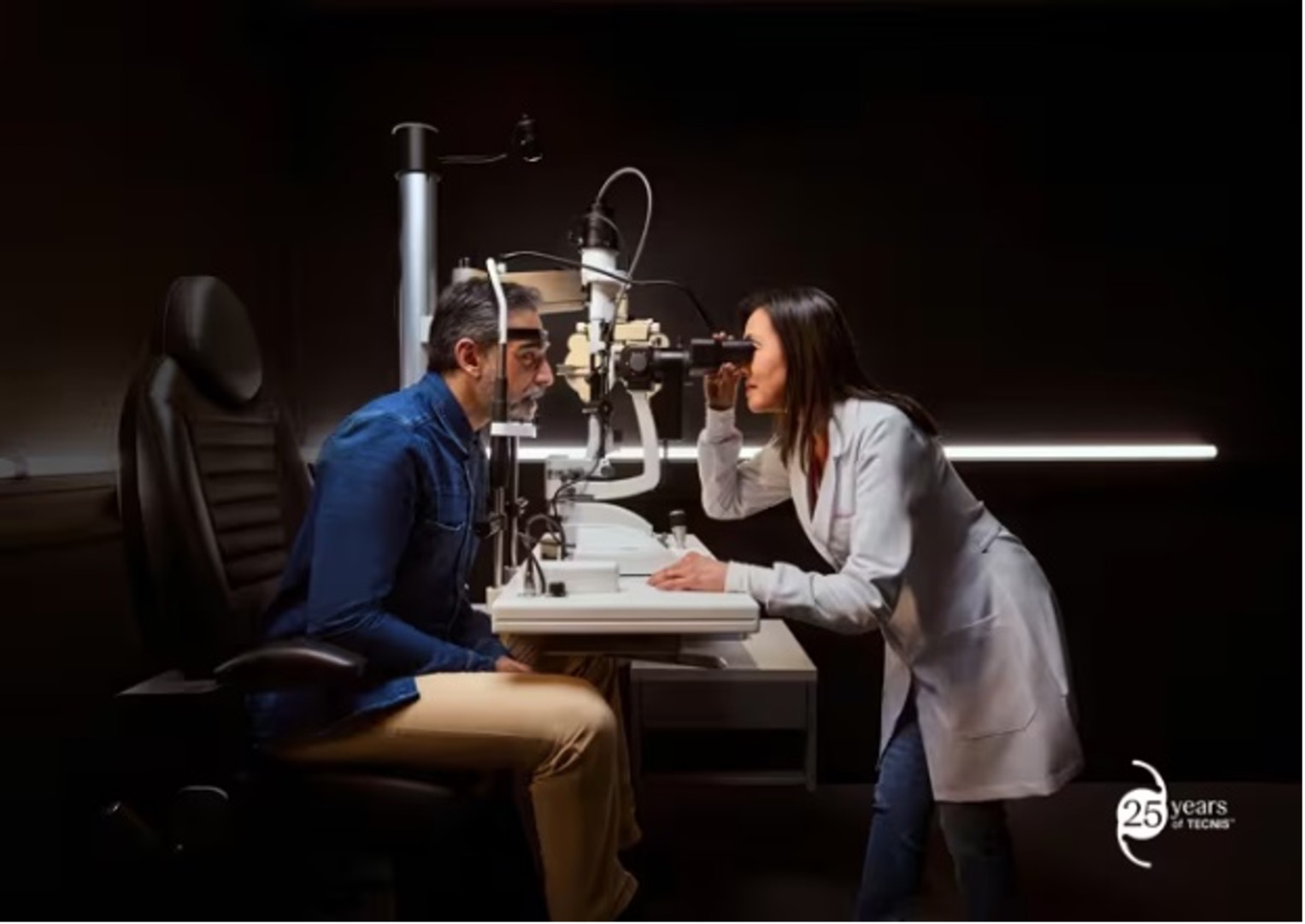
For 25 years, Johnson & Johnson’s TECNIS™ platform has been shaped by scientists, engineers, designers, and manufacturing leaders connected by a shared curiosity about vision, and a responsibility to the patients who depend on their decisions.
Some were there at the beginning. Others joined along the way. Together, their voices offer a rare view into how long‑term research is built, sustained, and carried forward — and why that continuity matters when innovation directly affects how people see the world.
It started with a question
When TECNIS™ was first envisioned, it didn’t come from a product brief or a market gap. It started with a simple question: Why doesn’t vision after cataract surgery feel as natural as it could?
“The lenses on the market at the time weren’t really matching how the eye works,” recalls Sieger Meijer, Platform Lead, Toric IOLs, Johnson & Johnson, who has spent more than three decades working on TECNIS™ development. “We knew the eye functioned as a system. The challenge was figuring out how to design for that system.”
Early research revealed something powerful: in a healthy, young eye, the cornea and the natural lens balance each other optically. That balance is lost with age, and further disrupted by traditional spherical lenses. Restoring it led to the first aspheric TECNIS™ intraocular lens in 2001.
“That principle became the foundation,” Meijer says. “Everything we’ve done since builds on it.”
Building something that lasts
From the beginning, TECNIS™ was never meant to be a single innovation.
“Our focus was understanding vision at a fundamental level and translating that science into better outcomes for patients,” says Patricia Piers, PhD, Head of R&D, Ophthalmic Implants, Johnson & Johnson.
“That mindset shaped how we approached every new lens.”
Instead of isolated designs, teams committed to a platform, protecting contrast and image quality while expanding what patients could do in daily life. Over time, TECNIS™ has advanced optical science through:
- Astigmatism correction (toric),
- Extended depth of focus,
- Enhanced monofocal technology,
- Presbyopia-correcting designs, and
- New approaches to delivering a broader range of vision without compromising quality.
Each advancement carried forward the same core intent to make vision feel more natural.
Designing for real life
As TECNIS™ evolved, the work became increasingly focused on how people actually experience the world—not just how they read an eye chart.
“Vision is subjective,” says Aixa Alarcón Heredia, Research Fellow, R&D Ophthalmic Implants, Johnson & Johnson. “Two patients can have the same lens and experience it very differently, with different symptoms.”
That reality pushed teams to develop new ways to connect patient experience with measurable design inputs, especially when addressing visual disturbances like glare or halos.
“We’re not just designing optics,” Alarcón Heredia says. “We’re designing how people read, drive, recognize faces. How they move through the world.”
When scale changes everything
For engineers like Bram Koopman, the responsibility of that work becomes clearer as TECNIS™ reaches more patients.
“When you realize how widely these lenses are used, it changes how you think,” says Koopman, Principal R&D Engineer, Johnson & Johnson. “Every design decision has real consequences for millions of people.”
Consistency matters as much as innovation. Designs must perform predictably across different patients, surgeons, and environments, without sacrificing quality of vision.
Making the invisible measurable
Behind every lens design is an equally demanding effort to measure performance in ways that reflect real‑world vision.
“Innovation only works if measurement keeps up,” says Mihai State, Senior Principal R&D Engineer, Ophthalmic Implants, Johnson & Johnson.“Otherwise, design becomes constrained.”
State and his colleagues develop tools that connect optical performance to expected patient experience. Often, that means measuring things no one needed to measure before.
“Those are the hardest problems,” adds Mark Jenkins, Principal Scientist, R&D, Vision, Johnson & Johnson. “But they’re also where the most meaningful progress happens.”
Some of these measurement methods have gone on to inform broader industry standards, quietly shaping how vision is evaluated well beyond TECNIS™.
From idea to reality
One reason TECNIS™ development moves forward with confidence is the proximity of R&D and manufacturing.
“Having design, testing, and manufacturing working side by side changes everything,” says Roy Reints, Front End Innovation Platform Lead, Johnson & Johnson. “You learn faster.”
For Klaas Sikkens, Principal Engineer, that closeness ensures ideas can scale. “What we design has to work thousands of times, not just once,” he says. “Developing on the same lines where lenses are produced makes that possible.”
When the work hits home
For many on the TECNIS™ team, the impact of their work became clearest outside the lab.
Several describe moments when a parent, relative, or close colleague needed cataract surgery—suddenly turning years of research into something intensely personal.
“When someone you love gets their sight back, it changes how you see your work,” says Selma Boersma, Manager IOL Development, Johnson & Johnson. “You realize those design decisions matter far beyond the lab.”
These moments are what sustain the long hours, the careful debates, the repeated testing.
Still building
At 25 years, TECNIS™ isn’t viewed as a finished success.
“The platform has become a standard,” Meijer reflects. “Now the responsibility is to keep building on it.”
That responsibility is shared across generations of R&D teams — some who remember the earliest prototypes, and others who are shaping what comes next.
Driven by curiosity, grounded in science, and carried forward by people who care deeply about the outcome, TECNIS™ continues to evolve, helping patients see clearly, and helping its innovators remember why this work matters.
For Important Safety Information.