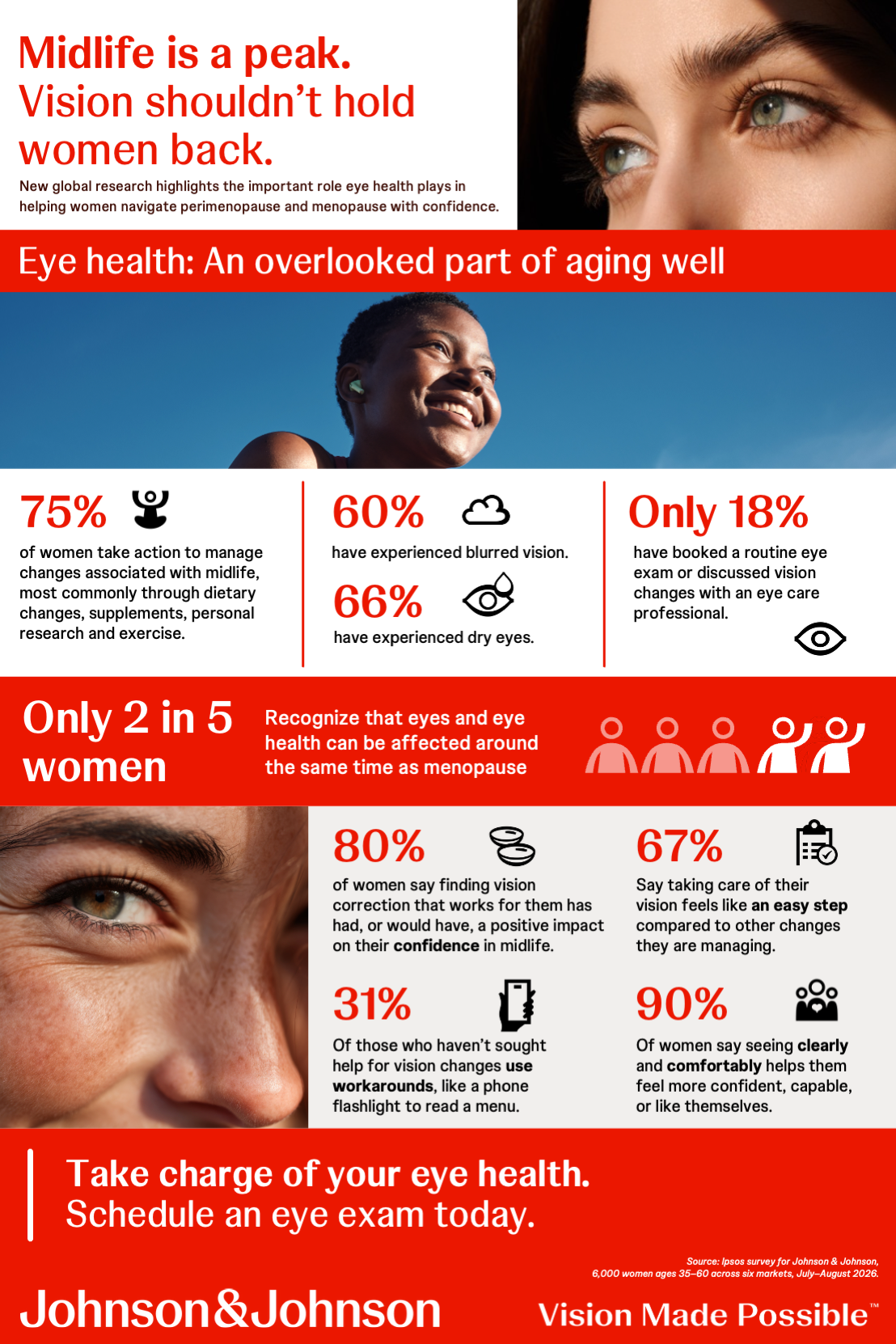
JACKSONVILLE, Fla., October 1 — Johnson & Johnson today released new findings that show most women know menopause can affect mood and sleep, but fewer than half realize their eye health may change too. A new global survey of 6,000 women found that only 40% connect eye changes with the menopause transition—even though 90% say seeing clearly and comfortably helps them feel confident, capable or like themselvesi.
During Menopause Awareness Month, Johnson & Johnson is continuing its collaboration with Academy Award–nominated actress, entrepreneur and menopause advocate, Naomi Watts. The American Optometric Association (AOA) is supporting the effort to encourage women to recognize eye and vision changes and speak with an eye care professional.
“We’re talking more openly about menopause, but eye health is still too often left out,” said Naomi Watts, founder of Stripes Beauty. “I want women to know they don’t have to quietly work around changes like dry eyes or blurry vision. An eye exam is a simple step that can help them understand their eye health options and feel more in control.”
A common—but often overlooked—midlife change
The new survey, conducted across the United States, United Kingdom, Brazil, South Korea, Japan and China, points to a clear awareness gap. While 75% of women have taken action to manage changes associated with midlife, only 18% have booked an annual eye exam as part of that routine.
The survey also found:
- 66% have experienced dry, gritty or irritated eyes, and 60% have experienced blurred vision.
- Only 18% have discussed these changes with an eye care professional.
- Among women who have not sought help for vision changes, 31% have used a phone flashlight to read a menu or relied on other workarounds, such as enlarging text or holding reading material farther away.
“Too many women are simply adapting to midlife vision changes without realizing there are solutions available,” said Dr. Charissa Lee, Head of Professional Affairs, Vision, Johnson & Johnson. “By making eye health part of the menopause conversation, we can help women find the options that support clear, comfortable vision and everyday confidence.”
Midlife vision changes can happen at the same time as the menopause transition and its possible eye health changes. Symptoms may include dry or irritated eyes, blurry near vision, headaches, or needing to hold reading material farther awayii. A comprehensive eye exam can help identify what is changing and which options, like multifocal contact lenses, may better support the patient’s lifestyle.
Turning awareness into action
Watts will continue sharing her eye health journey and encouraging women to include vision in their midlife wellness routine. The AOA will encourage women to make comprehensive eye exams part of their midlife health care and provide doctors of optometry with resources to support conversations about eye and vision changes and available care options during menopause.
"Eye and vision health needs to be part of the broader health conversation as women navigate menopause," said Teri K. Geist, O.D., AOA Presidentiii. "A comprehensive eye exam and an open dialogue with your doctor of optometry can help women understand the changes they may be experiencing, identify eye health concerns they may not notice on their own and get the care they need to see and feel their best."
Three simple steps for women:
- Notice changes: Pay attention to dryness, irritation, blurry near vision, headaches or growing reliance on workarounds.
- Book a comprehensive eye exam: Don’t wait until vision changes interfere with daily life. An annual in-person comprehensive exam is an important part of overall health care and can assess eye and vision health and help identify appropriate solutions.
- Start the conversation: Tell an eye care professional about menopause-related health changes and how vision is affecting work, reading, driving or other daily activities.
Women can learn more, take a lifestyle quiz and find a local eye doctor nearby by visiting the Vision Made Possible website.
*Disclosure: This is a paid endorsement. Naomi Watts was compensated for this quote.